
Wigtown is a small town and former Royal Burgh in Wigtownshire, within Dumfries and Galloway in south-west Scotland. It sits on the Machars Peninsula overlooking Wigtown Bay and is best known today as Scotland's National Book Town, with a dense cluster of bookshops, an annual Wigtown Book Festival and a lively literary culture.
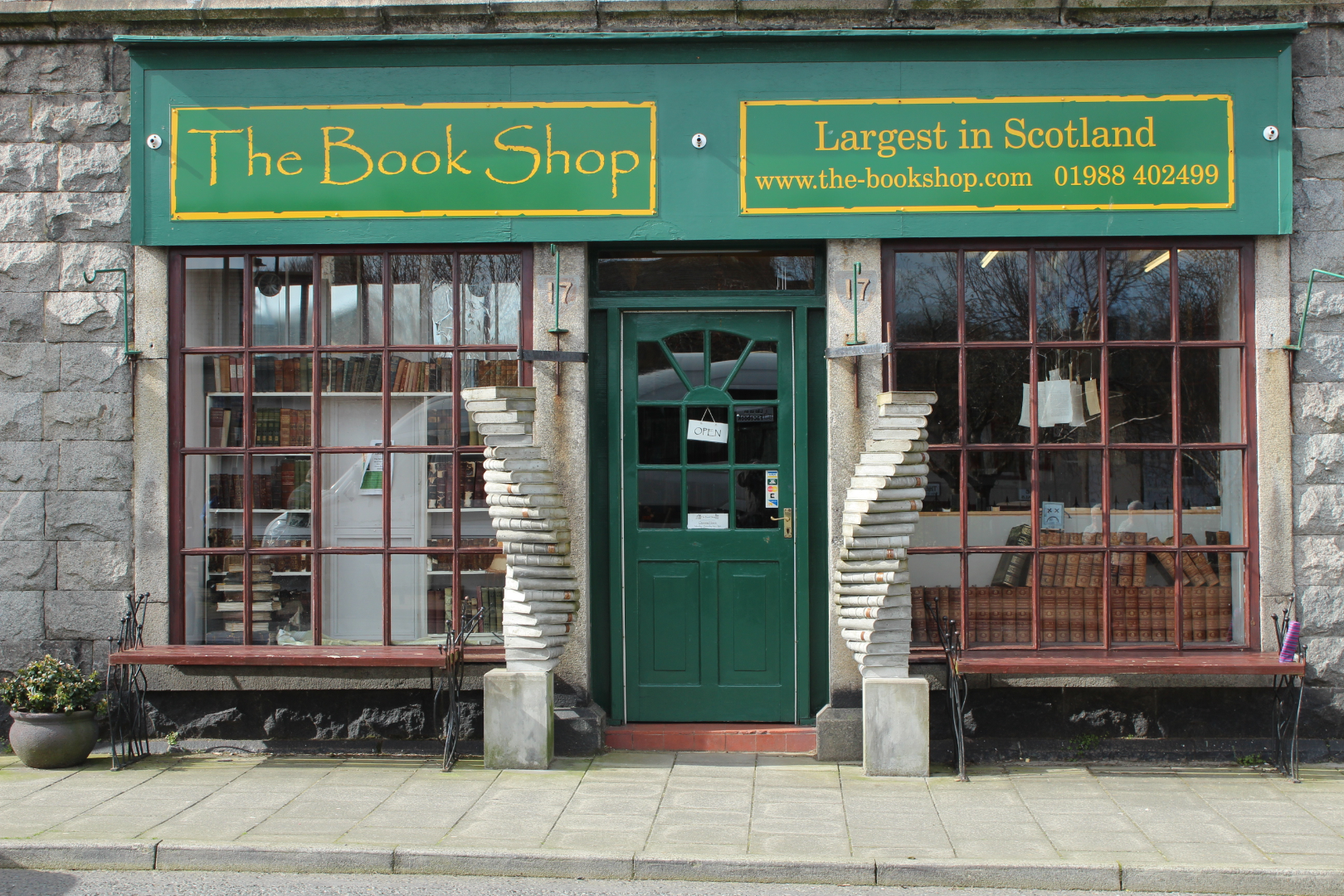
The Bookshop on N Main Street in Wigtown
# Scotland’s National Book Town Today Wigtown’s wide main street and square hold a remarkable density of book-related businesses, from general second-hand emporia to specialist dealers, children’s shops and tiny one-room curiosities. Some are long-established; others are pop-ups or seasonal experiments that change from year to year, keeping the town’s cultural ecology in motion. The best-known shop, often simply called The Bookshop, is reputed to be Scotland’s largest second-hand bookshop, famous both for its mile-long shelves and for the acerbic humour of its owner. Nearby, The Open Book invites visiting readers to take over the running of a small bookshop for a residency, blurring the line between tourism, apprenticeship and participatory art.
# Location Wigtown lies a little south of Newton Stewart and east of Stranraer, on a low hill above the tidal River Bladnoch where it meets the Cree estuary and opens into Wigtown Bay. On clear days the town looks across the mudflats to the Galloway Hills, with long horizons that make it feel both sheltered and open to the wider seascape.
SEARCH Wigtown 54.8687022, -4.4415694 Wigtown, Dumfries and Galloway, Scotland, DG8 9JH, United Kingdom
The surrounding Machars Peninsula is a patchwork of pasture, small farms, woods and rougher coastal ground. Wigtown Bay itself is a rich habitat for waders and wildfowl, and the nearby nature reserve has become known for ospreys, wintering geese and big skies that change character by the minute.
# Historical roots
The settlement at Wigtown has medieval origins and grew into the county town of Wigtownshire, with royal burgh status granting it trading privileges and a formal civic identity. Its position near the head of Wigtown Bay made it an early port, with traffic across the estuary and connections along the Solway and Irish Sea.
Wigtown Church and the Salt Marsh.
Over the centuries the town absorbed layers of influence from Gaelic, Norse and Scots speaking communities along the south-west coast. Much of that history is now read through church sites, old street patterns, and the long memory of local families who have farmed and traded in the area for generations.
# The Wigtown Martyrs One of the most poignant episodes in the town’s story is the fate of the Wigtown Martyrs, two Covenanter women executed by drowning in the 1680s for refusing to renounce their religious convictions. Their story has become part of the spiritual and moral landscape of the town, shaping how people talk about conscience, authority and the costs of dissent. Visitors can still find the Martyrs’ graves in the parish kirkyard and the monument at the traditional drowning place on the shore. A small prison cell preserved within the County Buildings recalls their imprisonment and the way a provincial burgh could become entangled in the wider conflicts of the Scottish Reformation and its aftermath.
# From port town to book town Wigtown’s fortunes rose and fell with changes in trade, transport and administration. The harbour silted and declined, new routes drew commerce elsewhere, and by the late twentieth century the town had lost key employers and much of its economic base, even as it retained its role as a modest service centre for the surrounding rural area. In the 1990s a national search was launched to create a Scottish Book Town on the model of Hay-on-Wye. Wigtown put itself forward and was eventually chosen as Scotland's National Book Town, turning vacant shops and fading buildings into bookshops, galleries, cafes and small creative businesses. That decision became a turning point, seeding a long process of community-led regeneration.
# Festivals and events The Wigtown Book Festival runs for around ten days each autumn and has grown into one of Scotland’s leading literary festivals. It mixes headline authors with poets, historians, children’s writers, local voices and experimental events, often spilling from formal venues into back rooms, gardens, churches and repurposed sheds. Alongside the book festival the town hosts an agricultural show with roots in the early nineteenth century, and newer community events such as music weekends and small arts festivals. Together they create a yearly rhythm that balances rural traditions with contemporary cultural life.
# Landscape and wildlife Wigtown Bay is one of the defining presences in the town’s identity. At low tide vast mudflats and sandbanks appear, threaded with channels and patterns of water that catch the light in endless variations. At high tide the bay becomes a shallow inland sea that draws in flocks of birds and gives the town a gently maritime feel despite its distance from the open ocean. The surrounding low hills and hedgerows give easy access to walking routes that loop through farmland, woodland and shore. For many visitors the simple act of slowing down to the pace of a small town, watching the weather drift across the bay and browsing shelves between walks is as important as any specific attraction.
# Wigtown in story and imagination Wigtown’s reinvention as a book town has itself become the subject of books and stories. Memoirs and diaries by local booksellers and residents have turned the town into a minor character in contemporary Scottish writing, portraying it as a place of gentle eccentricity, sharp humour and stubborn community resilience. The town also appears in wider popular culture, lending its name to the fictional Wigtown Wanderers in the Harry Potter universe and cropping up in documentaries, travel writing and radio features about rural creativity. In that sense Wigtown functions both as a very concrete place of stones, fields and tides, and as a symbol of how a small community can rewrite its own narrative around books and imagination.